

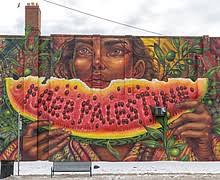

On a stretch of Brookland Park Boulevard, a single mural has become a citywide conversation.
Painted on the side of a neighborhood building, the artwork depicts a dark-skinned Palestinian woman holding a slice of watermelon, its seeds spelling out “Free Palestine.” Since appearing in December, the mural has drawn sustained attention—not for its political stance alone, but for how its imagery resonates within Richmond’s Northside.
What began as a work of international solidarity has evolved into a layered local debate about race, history, neighborhood voice and the responsibilities of public art.
By late February, community leaders began publicly challenging the mural. Among them were civil rights activist Gary Flowers, Richmond SCLC president Bill McGee, NAACP Richmond Branch president J.J. Minor and former Richmond Crusade for Voters president Jonathan Davis.
Their critique was specific. While acknowledging the watermelon’s meaning within Palestinian resistance—where it symbolizes the colors of the Palestinian flag—they argued the image carries a different, painful history in the United States. In Black communities, the watermelon has long been used as a racist trope, weaponized in caricature and propaganda.
Placed in a historically Black neighborhood, they said, the mural cannot be separated from that context.
The criticism quickly expanded beyond symbolism. Opponents questioned how such a prominent piece of public-facing art could appear without broader community input, particularly along a corridor that has long been a cultural and economic anchor for Black Richmond.
In this framing, the issue is not censorship but process: who gets consulted, who gets considered and who bears the impact of what goes on neighborhood walls.
At the center of the mural is Los Angeles–based artist Lauren YS, who has said the work was intended as an expression of solidarity with Palestinians amid ongoing violence in Gaza. Scholars and supporters have echoed that reading, noting the watermelon’s long-standing role in Palestinian visual culture, especially during periods when the Palestinian flag was restricted.
For some Richmond residents, that context matters. They see the mural as part of a broader tradition of linking global struggles with local ones—drawing parallels between Palestinian resistance and Black liberation movements in the United States.
Others, however, argue that intention does not override impact. Even those who find artistic or political value in the work have described a tension between what the mural means globally and how it feels locally.
That tension has been especially visible in Northside, where layers of history—segregation, disinvestment, cultural displacement—shape how images are read. In that context, critics say, symbolism cannot be imported without translation.
As the debate unfolded through March, it became clear the mural was functioning as more than a single artwork. It became a proxy for broader questions: how Richmond defines public art, how neighborhoods navigate change and how different histories coexist—or collide—in shared space.
The building’s owner, Teresa Sharpe, has remained a central figure in that conversation. Sharpe has said she anticipated some controversy tied to the mural’s political message, but not the specific concerns raised by local residents. She has maintained that the mural will remain, while also signaling openness to continued dialogue.
That dialogue reached a new stage this week at a town hall held at the Richmond Main Library. Residents, artists, organizers and community leaders filled the space for a public discussion that reflected the complexity of the issue.
There was no consensus.
Some attendees reiterated that the mural represents solidarity and should be understood within a global political context. Others emphasized that public art in Black neighborhoods carries a different weight—one that requires deeper consultation and cultural awareness before a piece is installed.
Across perspectives, a few themes held steady: the importance of context, the limits of intention and the need for clearer pathways for community input.
The town hall also highlighted a structural gap. Under current city practice, murals on private property do not require a formal public approval process. That reality has sharpened calls for updated guidelines—particularly for large-scale works that function, in practice, as public art.
Sharpe has proposed next steps that include adding a plaque to contextualize the mural and hosting additional events, including a teach-in connected to Palestinian history and symbolism. Whether those measures will shift public sentiment remains unclear.
What is clear is that the mural has already reshaped conversation in Richmond.
For critics, it underscores the necessity of grounding public art in local history, especially in neighborhoods where that history includes racial harm. For supporters, it affirms the importance of connecting Richmond to global movements and resisting the idea that solidarity must be confined by geography.
Between those positions is a more complicated reality—one where both readings can exist at once.
The Brookland Park mural has revealed how quickly a wall can become a mirror, reflecting not just an artist’s intent but a community’s memory, identity and unresolved tensions. It has also exposed a civic gray area, where private property intersects with public life and where art, once installed, belongs as much to the street as it does to its creator.
In that sense, the question facing Richmond is larger than this single mural. It is about what public art owes the people who live with it—and what it means to create work that speaks across histories without erasing the ones closest to home.



Leave a Reply