

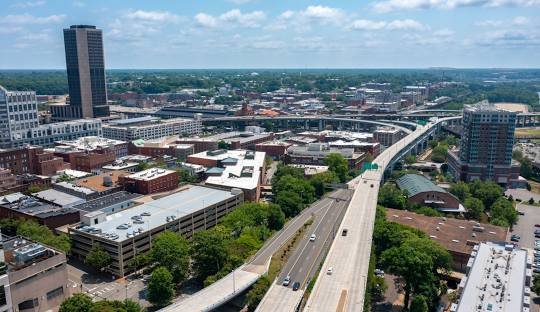

Once defined by warehouses, rail corridors, and late-night foot traffic, Shockoe Bottom is steadily reshaping itself into one of the city’s most active and layered redevelopment zones. The shift isn’t happening through sweeping megaprojects, but through a series of adaptive reuse efforts that, taken together, are redefining how the neighborhood functions — and who it’s for.
At the center of this transition is a growing pattern: historic and industrial buildings being reimagined as residential spaces, boutique commercial hubs, and experience-driven destinations. Projects like the Broom Factory Lofts, a former manufacturing facility converted into condominiums, signal how older structures are being repositioned for a different kind of urban life — one that prioritizes density, walkability, and mixed-use activity.
That pattern is now extending to even more prominent sites. The recent listing of the former Henrico County courthouse and jail complex adds a new layer to the neighborhood’s evolution. Unlike typical warehouse conversions, the courthouse carries over two centuries of civic history, making its future not just a development question, but a cultural one. Its potential reuse — whether residential, hospitality, or hybrid — reflects a broader shift: properties once tied to public or industrial use are entering a new phase as flexible, market-driven spaces.
What’s emerging in Shockoe Bottom is not a single identity, but an overlap of several. Residential infill is bringing more full-time residents into an area long dominated by nightlife. At the same time, restaurants, bars, and entertainment concepts continue to anchor the neighborhood as a destination. Increasingly, there is also space for creative and cultural uses — galleries, studios, and event-driven venues — that align with Richmond’s broader arts ecosystem.
This layered growth is part of what makes the Bottom’s transformation feel distinct. It’s not a clean break from the past, but a gradual reworking of it. Brick warehouses remain, but their interiors are changing. Historic facades stay intact, while their uses shift dramatically. The result is a neighborhood where history is not erased, but continuously repurposed.
Still, the pace of change raises familiar questions. As investment accelerates, so does the tension between preservation and redevelopment. Shockoe Bottom carries deep historical significance, and decisions about how its buildings are used — and interpreted — continue to shape public conversation. New projects bring energy and economic activity, but also invite scrutiny about whose stories are centered and how the area’s identity evolves.
What’s clear is that Shockoe Bottom is no longer a peripheral district waiting on reinvestment. It is actively absorbing it. And as more properties — including landmark civic sites — come onto the market or into redevelopment pipelines, the neighborhood is positioning itself as a key frontier in Richmond’s next phase of urban change.










Leave a Reply